



By Jorge Casuso
September 21, 2026 – The City Council on Tuesday is expected to give final approval to an ordinance that paves the way for large transit-oriented (TOD) housing developments in Santa Monica's most diverse and least expensive single-family neighborhood.
Homeowners in the Pico Neighborhood's Gandara Park area said they will continue fighting to stave off the immediate impacts of SB 79, a state law that allows multi-family developments of up to five stories within half a mile of the city's seven major transit zones.
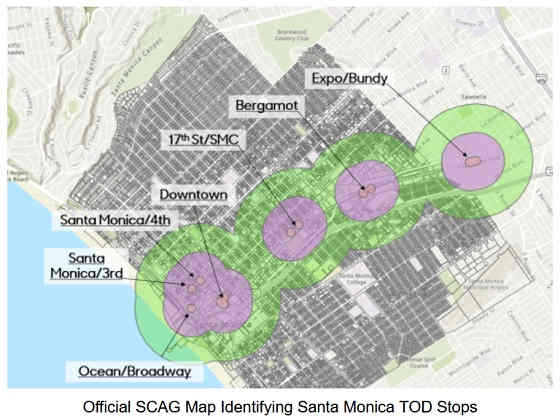 |
SB 79 , however, allows the City to temporarily delay for one year applying the law to areas that are already zoned for sufficient housing capacity. The only area that failed to qualify for the exemption was the zone around the Expo Bundy rail station, where the Gandara Park Neighborhood -- bounded by the I-10 Freeway to the South, Dorchester Avenue to the West, Exposition Boulevard to the North, and Centinela Avenue to the East -- is located.
On July 28, the Council voted 5 to 1 -- with Councilmember Lana Negrete opposing -- to allow the development to take place on the 89 single family parcels in the Gandara Park area, instead of on 66 parcels zoned multi-unit residential north of the 10 Freeway.
The vote came after the Council considered the "potential involuntary displacement risks" on the multi-family parcels, according to staff.
But on September 8, when the Council approved the ordinance on first reading to increase development standards in the Gandara Park area, staff noted "there would be no or low displacement risk for all 66 parcels" zoned for multi-family housing.
Despite the slim chances the Council will reverse its vote on second reading Tuesday night, Gardera Park area residents say they haven't given up.
"We're going to fight it," said former City Councilmember Christine Parra, a Gandera Park area homeowner who is leading the opposition. "We're going with guns blazing."
Parra said residents surveyed the households living on the 89 affected parcels and found that one in five are renters. Many of the owner-occupied units have been passed down or, as in her case, was the only affordable option to own a home in the city she grew up in.
Parra and her husband competed with some 50 buyers to purchase "a house with 23 broken windows and shag carpet" and "spent everything we had," she said.
"It just hurts that now I'm going to be worried about my neighbors selling because (the Council) sold out to developers and it means nothing to them."
The transformation is already starting. The Council's vote immediately opened the door for two proposed developments, including a 12-story condo building with 32 units to replace an unoccupied single-family home at 1517 15th Street.
In an open letter last week, the Pico Neighborhood Association (PNA) called out the Councilmembers who voted to upzone the area "without reliable data on who actually lives in the affected homes."
The Board noted that the Pico Neighborhood "has already been cut in half by a freeway, has already absorbed the region's transit infrastructure, and has already been treated as this city's dumping ground for uses no one else wanted," the letter stated.
Gandara Park neighbors, who mounted a lobbying effort that included a website, had urged the City to explore placing the development across the border in Los Angeles, which is within the Bundy light rail TOD zone.
City staff rejected that option in a report to the Council for the second reading of the ordinance Tuesday night. They noted that last Thursday the State's Department of Housing and Community Development (HCD) met with City staff.
"Based on their review of the legislative history of the statute and considering the practical implementation challenges, HCD’s position is that jurisdictions may only consider the parcels and data within their own jurisdictional boundaries," staff wrote.
While SB 79 was opposed by 131 California cities, Santa Monica was one of only five cities that supported the bill, with Negrete casting the lone opposing vote.
Assemblymember Rick Zbur, who represents West Hollywood and Santa Monica, led the opposition to SB 79 despite the backing of the City Councils in both cities, arguing the bill would initially impact lower-priced single-family neighborhoods.
“The neighborhoods most affected by this are not necessarily the ultra-wealthy,” Zbur said when the bill was approved a year ago. “Instead, lower-priced areas will be the first to feel the impacts because land costs are lower.
"These are places where people have already made incredible sacrifices to live," Zbur said. "They are built-out single-family neighborhoods, where homeowners bought with the expectation that they could raise their kids in a stable, safe community they understood.”
The passage of SB 79 was applauded by pro-housing advocates who backed the candidates on the 6 to 1 super-majority on the Council.
California YIMBY, which for a decade has pushed for housing density in affluent urban cities with major transit lines, such as Santa Monica, called SB 79's passage the fulfillment of an elusive dream.
"Today, California YIMBY achieved one of its founding goals: legalizing apartments and condos near train stations,” the group's CEO Brian Hanlon said when the bill was passed.
“We won many victories over the past eight years, but the dream of passing a robust, transit-oriented development program has long eluded us, until now."